
If you run a small or mid-sized business, you probably recognize this feeling.
You didn’t start your company to spend your days approving requests, chasing updates, or manually connecting systems that should already talk to each other. Yet that’s exactly where many leadership hours disappear.
A manager checks sales updates.
An HR lead follows up on onboarding paperwork.
Accounting tracks invoices and payments across different tools.
Even with modern software, much of the work still involves coordinating tasks, checking progress, and moving information between systems.
Many organizations have already started experimenting with artificial intelligence — chat tools, automation, and AI assistants. And the results are beginning to show. In fact, research shows that 91% of small and mid-sized businesses using AI report it helps boost revenue and growth.
But most AI today still works like a tool. You ask a question. You press a button. You guide the process.
A new model is emerging that changes this dynamic: Agentic AI.
What Is Agentic AI?
Most AI tools today are assistants.
You ask them to write an email.
Generate a report.
Summarize a document.
They respond quickly and help you complete the task.
Agentic AI works differently.
Instead of simply responding to prompts, agentic AI is designed to work toward a goal.
You define the outcome, and the system determines the steps needed to achieve it. It can coordinate tasks, interact with multiple tools, check its progress, and complete workflows with minimal intervention.
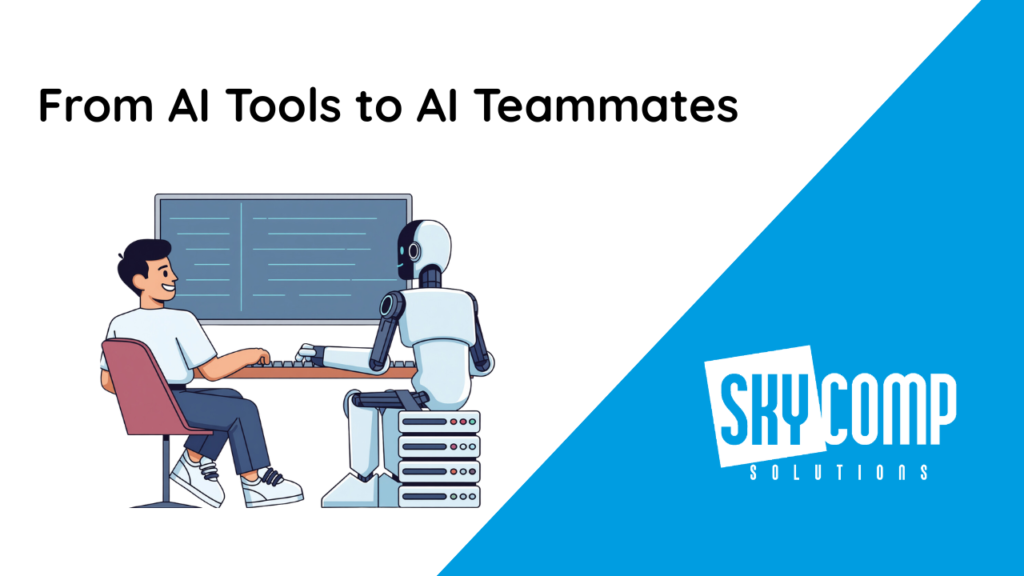
Think of it less like software and more like a digital teammate.
Instead of asking AI to draft a follow-up email, you assign it the goal of following up with customers — and it manages the process from start to finish.
This shift from “tool” to “teammate” is what makes agentic AI so powerful.
What Agentic AI Could Look Like Inside a Business
For many small and mid-sized organizations, the biggest challenge isn’t lack of ideas — it’s the constant coordination required to keep operations running smoothly.
Agentic AI can help remove much of that friction.
Imagine a few simple scenarios.
In sales, an AI agent could monitor incoming leads, update the CRM automatically, schedule follow-up meetings, and prepare a summary for the sales team.
In HR, it could guide new employees through onboarding steps, answer common policy questions, and send reminders for required training.
In accounting, AI agents could review invoices, track payments, flag unusual spending, and prepare financial summaries.
None of this replaces employees. Instead, it removes the repetitive coordination work that slows teams down and distracts them from higher-value tasks.
The goal is simple: let people focus on decisions, relationships, and strategy while routine execution happens reliably in the background.
Why This Matters for Small and Mid-Sized Businesses
Large enterprises often solve operational complexity by adding more layers of staff and management.
Small and mid-sized businesses rarely have that option.
Growth often means asking existing teams to handle more work, more systems, and more coordination.
That’s where agentic AI becomes particularly powerful.
It allows businesses to operate with a level of consistency, speed, and discipline that previously required much larger teams. Processes become more reliable. Information flows more smoothly. Teams spend less time tracking work and more time moving the business forward.
In other words, agentic AI removes friction.
And for growing businesses, reducing friction can make a meaningful difference in productivity and scalability.
Where Microsoft Copilot Fits Into This Shift
For most businesses, the move toward AI will happen through tools they already use every day.
That’s where Microsoft Copilot plays an important role.
Because many organizations already run their operations on Microsoft technologies — Windows, Microsoft 365, Outlook, Teams, and SharePoint — Copilot can bring AI capabilities directly into those familiar environments.
Instead of adopting entirely new systems, businesses can start integrating AI into the workflows they already rely on.
Copilot can help summarize meetings in Teams, assist with document creation in Word, analyze data in Excel, and streamline communication across Microsoft tools. Over time, these capabilities will evolve into more advanced workflows that resemble the agentic AI model.
For businesses already working within the Microsoft ecosystem, this makes the transition to AI far more accessible.
AI Is Also Becoming Part of the Devices We Use
Another major shift is happening at the device level.
AI is no longer limited to cloud applications — it’s increasingly built directly into operating systems and hardware.
New Copilot+ PCs and Windows 11 devices are designed to support AI-powered features directly on the machine, enabling faster performance and more secure processing of data.
For businesses, this means AI won’t always require separate software or platforms. It will gradually become part of the everyday technology employees already use.
The combination of AI-enabled devices, Microsoft Copilot, and evolving agentic AI capabilities is helping shape the next generation of workplace productivity.
AI Needs Guardrails
As exciting as these developments are, successful AI adoption isn’t just about technology.
It’s about governance.
Businesses must think carefully about questions like:
Who has access to which data?
What information should AI systems be allowed to use?
How are decisions reviewed and monitored?
AI works best when it operates within clear boundaries. Without proper oversight, organizations risk exposing sensitive data or creating processes that lack accountability.
That’s why the starting point for adopting agentic AI isn’t tools — it’s intent, governance, and clarity on outcomes.
How Businesses Should Start Exploring Agentic AI
For organizations interested in exploring AI, the best place to begin is not with software purchases.
Instead, start by looking at your workflows.
Ask questions such as:
Where does our team spend time on repetitive coordination work?
Which processes require constant follow-up or manual updates?
Where do systems fail to communicate with each other?
These are often the areas where AI can deliver the most meaningful improvements.
At Skycomp Solutions, we’ve been actively exploring how businesses can safely and effectively prepare for this shift.
Recently, we hosted a Prompt-a-thon event where we worked with organizations to explore AI and Microsoft Copilot in a controlled lab environment. The session covered practical topics such as prompt creation using the GCSE framework, the role of AI-enabled devices, and the security considerations involved when working with tools connected to large AI models.
One of the most important lessons from these discussions is that AI readiness matters.
Before adopting AI tools, organizations should ensure their security policies, data access permissions, and governance frameworks are in place. Knowing who has access to what information is critical when AI systems interact with business data.
The Bottom Line
Agentic AI represents an important shift in how technology supports business operations.
Instead of simply helping people complete tasks, AI systems are beginning to take responsibility for executing workflows and achieving outcomes. For small and mid-sized businesses, this shift has the potential to unlock new levels of productivity and efficiency.
But adopting AI successfully requires thoughtful planning, strong governance, and a clear understanding of where it can deliver the most value.
If you’re exploring how AI tools like Microsoft Copilot could fit into your organization, the team at Skycomp Solutions can help you assess your AI readiness, review your security framework, and identify opportunities to integrate AI responsibly into your business operations.
And if you’re not sure where to start, our experts are always happy to begin the conversation.